Posted 14.09.26
Economic Impact of Crystal Rig 4 Wind Farm
BiGGAR Economics was commissioned by Fred. Olsen Renewables to assess the economic impacts of the construction of the...
1 minute read


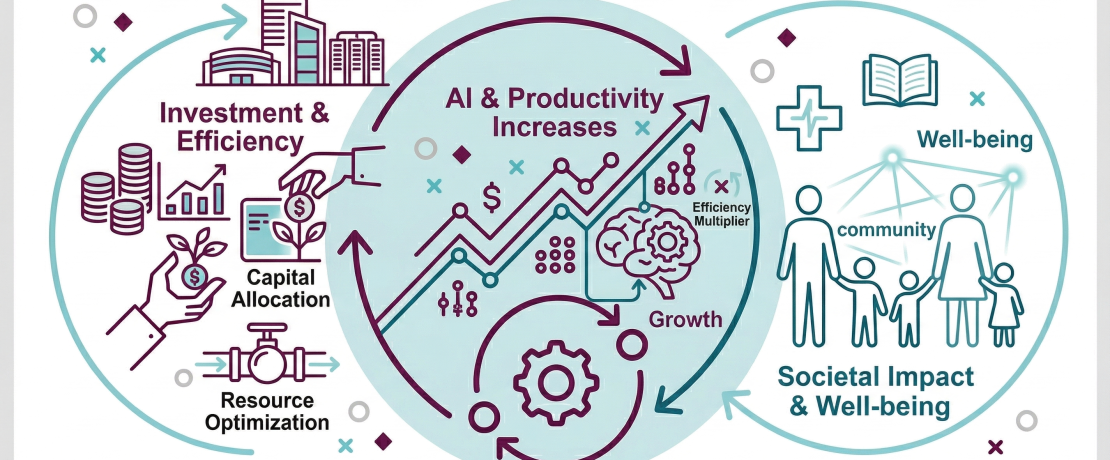
Artificial Intelligence (AI) is everywhere. In the news, in your LinkedIn feed and your email auto-response settings (note, it’s not the author of this post). It is also increasingly a theme across our work, including as part of funding bids to the Scottish and UK Government. For instance, digital and tech is one area of funding for Investment Zone initiatives and the subject of recent guidance by the UK Government’s Digital Service[1]. As of March 2026, Scotland has an AI Strategy[2] too.
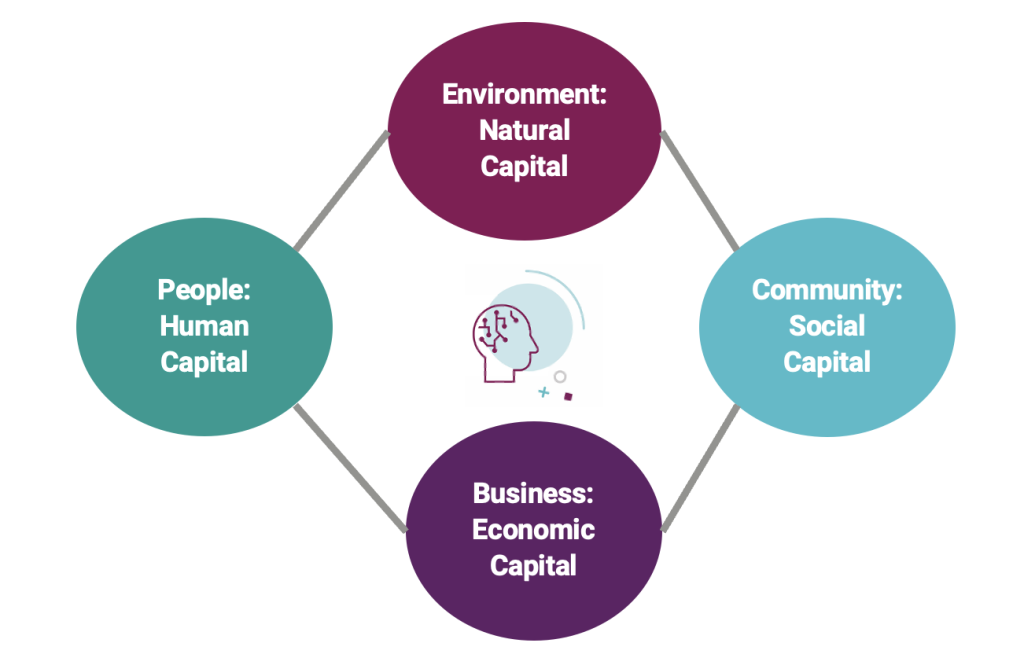
In a similar period of flux and uncertainty over the future of economic activity – the recovery from the Covid-19 pandemic – the Independent Advisory Group on Economic Recovery[3] suggested the use of the Four Capitals (Economic, Human, Natural and Social) Framework, as a way of considering changes in the economy. Our recent experience working in this space suggests that this approach can be useful for understanding the effects and ramifications from AI development and take-up.
So, how does AI relate to each of the four capitals?
While it may show up as a chat bot on your screen, AI is built on the backbone of physical infrastructure. It is an energy intensive technology requiring data storage and infrastructure. In this area, there is potential for developers and consultants to explore ways in which data centres could maximise socio-economic and wider benefits, as is currently done for renewable energy infrastructure[4].
Alongside their physical infrastructure, Large Language Models (LLMs) and other AI applications require data. Niche or sectoral models will need to combine high quality datasets across a range of dimensions. Since some challenges faced by Scotland are shared with other developed economies (e.g., an ageing population, or access to services in rural and island areas), there is an opportunity through careful, transparent and consensual data access to create products with export potential.
Commercialisation is also key to ensure Scotland is not only a user, but a producer of AI applications. This is likely to include a focus on entrepreneurship and industry-academia collaborations.
To fully secure the potentially transformational benefits from AI, it will be important for organisations to evolve their practices and invest in this new technology. This will involve up-skilling their workforce, learning from doing, re-modelling how organisations work and incorporating an AI-literate workforce. This includes the work of organisations supporting leaders and businesses in taking up AI, while also helping students accessing an increasingly difficult labour market. Similar programmes can support the shift towards a more conscious and impactful use of AI across the economy.
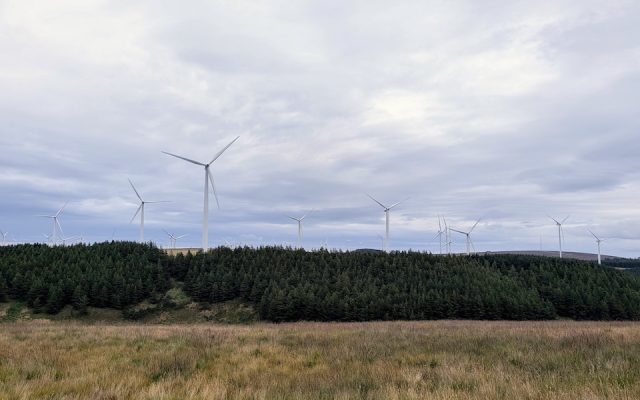
With the military targeting of data centres across the Gulf, recent conflict in the Middle East has shown how decisions on the location of this infrastructure are key, especially in an unstable geopolitical landscape. In addition to its security and attractiveness for investment, Scotland has another advantage for hosting the infrastructure associated with AI: its renewable resources. Given the industry’s energy intensity and Scotland’s abundance of renewable energy, there is a clear opportunity for mutual benefits.
Downstream uses of AI are already changing and will likely transform how people interact at work and across other spheres of life. Trust is one aspect that could be affected by the proliferation of AI-generated content and interactions between AI agents and people. Uncertainty over whether information is accurate could undermine trust, which is a building block of any successful society and economy. In a similar environment, businesses that can provide credible reassurance that the information they are providing is robust and based on human insight are likely to gain a competitive advantage. From our own experience as a business, this starts with developing an AI strategy, setting out guidance on good uses of AI and retaining human insight and experience at its core.
Be it to secure Government funding as part of new initiatives targeting tech and AI or as an organisation operating in this space, it is important to fully appreciate the wide-range of economic and wider impacts that your projects and activities could have. As an organisation seeking to have a meaningful impact, we appreciate the potential revolutionary benefits from AI and in an ever-changing landscape look to be a reference point for how to assess the economic and wider impacts from AI applications.
If you are interested in knowing more about how we can help, email us at andrea@biggareconomics.co.uk
[1] Government Digital Service (2026). Digital and Data Benefits Framework.
[2] Scottish Government (2026). Scotland’s Artificial Intelligence Strategy 2026-2031.
[3] Scottish Government (2020). Towards a Robust, Resilient Wellbeing Economy for Scotland. Report of the Advisory Group on Economic Recovery.
[4] Scottish Renewables (2025). Maximising Net Socio-Economic Benefit of Renewable Energy Guidance and Reporting Framework.
Posted 21.04.26
Our latest news
Posted 14.09.26
Economic Impact of Crystal Rig 4 Wind Farm
BiGGAR Economics was commissioned by Fred. Olsen Renewables to assess the economic impacts of the construction of the...
1 minute read

Posted 19.06.26
Football in Scottish Society since France ’98
It has been 28 years since Scotland last played in a World Cup. In that time, how has...
1 minute read

Posted 03.06.26
A Bespoke ESG Framework for the North Coast 500
An Environmental, Social, and Governance (ESG) framework is more than a reporting requirement; it is a roadmap for...
3 minute read