
Posted 12.10.26
Securing the Future of Scottish Brewing and Distilling
The alcohol sector makes a major contribution to the Scottish economy, amounting to around £ billion GVA/year and...
1 minute read


A new report from BiGGAR Economics examines the socio-economic impact of the Harris Tweed® sector. Born of domestic necessity, the production of Harris Tweed® evolved into a successful commercial enterprise in the early 1900s. It delivers substantial economic value while helping to sustain cultural identity and resilient populations in the Outer Hebrides.
In 2024, Harris Tweed® generated £16.8 million GVA and supported 520 jobs across Scotland. The jobs supported throughout the production process of Harris Tweed® alongside the brand’s contribution to tourism expenditure, make an important contribution to the Outer Hebrides economy. Scenery, landscape, history and culture were drivers of between £45.6 million and £69.3 million of the annual visitor expenditure in the Outer Hebrides in 2024. Harris Tweed® embodies these key drivers of tourism and is an important contributor to the tourism economy. It enriches the offering of the Outer Hebrides as a tourism destination and appeals to visitors across the world.
However the figures represent more than financial returns.
The 1993 Harris Tweed Act requires Harris Tweed® to be dyed, spun, handwoven, and finished on the Outer Hebrides.
This requirement anchors many of those working in industry to the Islands, where they generate economic activity and help maintain the working-age population in rural communities.
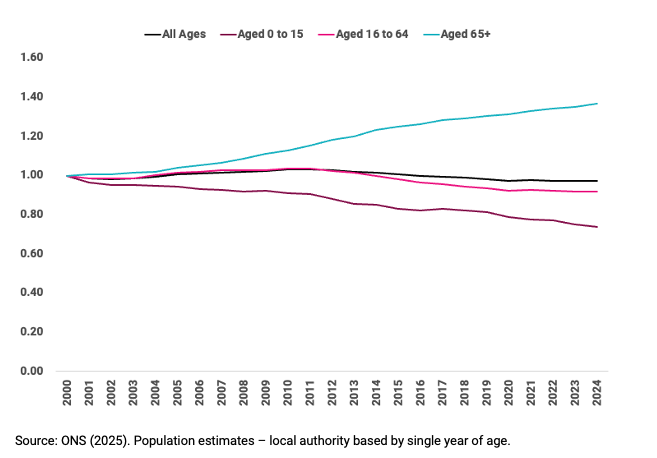
Figure 1 below shows that since the turn of the century, the overall population of the Outer Hebrides has fallen by 2.9%. However this masks rapidly increasing growth of those over 65 (+37%) and a considerable fall in the number of children (-26%). This trend is expected to continue, with the Outer Hebrides projected to lose almost a quarter of its working age population (-24%) between 2022 and 2043.
The total direct workforce of Harris Tweed® in the Outer Hebrides collectively represents 2% of the total employment in the Outer Hebrides. Against a backdrop of an ageing and declining population, these jobs, although small in number, are important in sustaining the population in some of the most remote communities in Scotland.
By generating economic activity and supporting employment opportunities in the Outer Hebrides, Harris Tweed® makes an important contribution to population retention on the Islands.
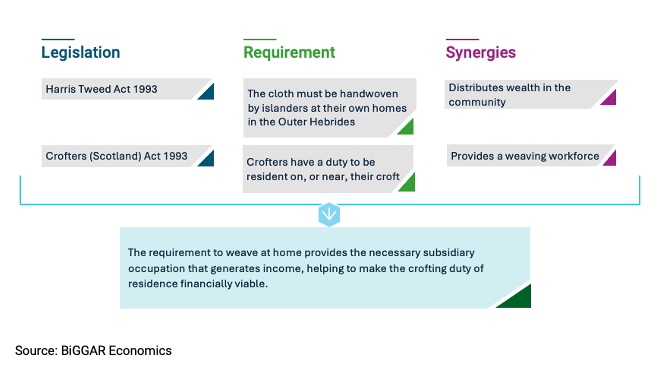
The legislative requirement governing Harris Tweed® requires weavers to live on the Islands. This is similar to the legislative requirements governing crofting, which include a duty for crofters to be ordinarily resident on or within 32km of their croft.
The crofting duty of residency helps provide the stable, distributed workforce necessary for the Harris Tweed® industry to operate. Similarly, Harris Tweed® supports crofting by providing weavers with flexible hours and a supplementary income that contributes to household finances. This allows crofters to balance the duties of tending livestock and crops with the demands of commercial weaving. Working the croft alongside other occupations is not only practical, but the combination of activities enables a crofting lifestyle to be financially viable.
As illustrated in Figure 2, the intersection of these legislative requirements creates a unique socio-economic model that helps sustain communities in the Outer Hebrides.
Having crofters and weavers securely embedded in the Outer Hebrides improves the overall resilience of the working population in the region. This helps to ensure the survival of what would otherwise be very fragile communities.
For further information about socio-economic impact assessments, please contact us at info@biggareconomics.co.uk
Posted 19.05.26
Our latest news
Posted 12.10.26
Securing the Future of Scottish Brewing and Distilling
The alcohol sector makes a major contribution to the Scottish economy, amounting to around £ billion GVA/year and...
1 minute read

Posted 08.10.26
Health Holland and the Dutch Life Sciences and Health Ecosystem
Beyond the Subsidy: Why Active Stewardship is the Key to Crowding in R&D Building a successful Life Sciences...
1 minute read
Posted 14.09.26
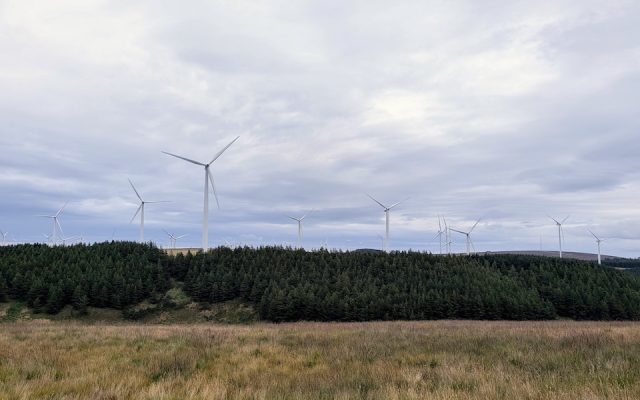
Economic Impact of Crystal Rig 4 Wind Farm
BiGGAR Economics was commissioned by Fred. Olsen Renewables to assess the economic impacts of the construction of the...
1 minute read