

Posted 12.10.26
Securing the Future of Scottish Brewing and Distilling
The alcohol sector makes a major contribution to the Scottish economy, amounting to around £ billion GVA/year and...
1 minute read


An Environmental, Social, and Governance (ESG) framework is more than a reporting requirement; it is a roadmap for understanding an organisation’s true impact. In complex sectors like tourism, where success depends on a diverse web of stakeholders, an ESG framework can provide the focus for collaboration and a commitment to a shared vision.
In early 2026, BiGGAR Economics developed a bespoke ESG Framework for North Coast 500 Ltd, the company responsible for promoting the iconic 500-mile touring route around the North Highlands. Here is how we moved beyond traditional reporting to capture the nuances of destination management.
In traditional corporate reporting, ESG focuses on the assets a company owns and controls. However, for a Destination Marketing Organisation (DMO) like North Coast 500 Ltd, the direct footprint is negligible. The real impact lies in indirect influence. While North Coast 500 Ltd employs a small core team, its reach extends to thousands of visitors, hundreds of local businesses, and dozens of fragile communities.
Standard corporate frameworks focus on financial materiality —issues that might harm a company’s value. In tourism, the most critical factors are often destination risks, such as overcrowding or infrastructure strain. These don’t appear on a balance sheet but threaten the long-term viability of the product. Similarly, tourism relies on resources like cultural heritage, Gaelic language, and a sense of place – assets that cannot easily be quantified.
To address these challenges, we developed a bespoke set of ESG outcomes and indicators tailored specifically to the NC500.
To build a framework that works for the NC500, we first had to understand the current reality. By supplementing desk research with three surveys for residents, businesses, and visitors, we built a bespoke quantitative model and analysed social and environmental impacts qualitatively.
In 2025 the NC500 generated £98.8M GVA and supported around 1,335 jobs in the North Highlands.
While increasing visitor numbers have brought economic benefits, the pressure on the environment and communities along the route was palpable. For example, survey responses consistently identified litter and human waste as major concerns, particularly during peak season.
How Often Residents Report Seeing Litter and Human Waste
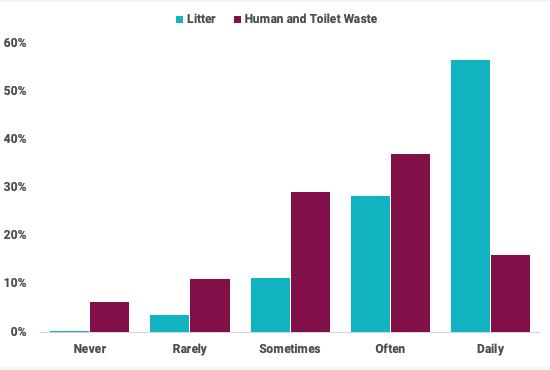
This is not a challenge unique to the NC500. Other tourism hotspots in the Highlands (and throughout the world) struggle to cope with high visitor numbers. Data gathered in 2025 by Highland Council Ranger Service shows inappropriate camping, litter, toileting and waste disposal in popular tourist hotspots all over the Highlands.
To compound this, the number of people visiting the NC500 is likely to continue to grow, creating both challenges and opportunities for communities.
We asked local people, business owners, and visitors to rank their priorities for the NC500. Remarkably, all three groups aligned on their top priorities: adequate infrastructure, engaged communities and leave no trace.
Ranking of Sustainable Tourism Outcomes: Survey Responses
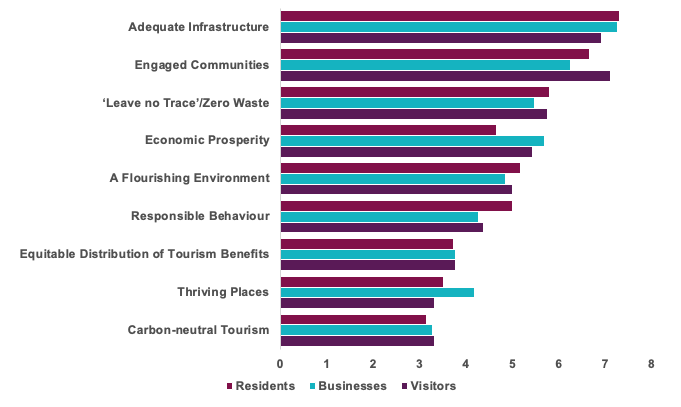
Other local organisations identified thriving places and maintaining a high-quality visitor experience as essential to sustaining the benefits of the route. Noting that effective management is required to mitigate the impact of rising visitor numbers.
We distilled these priorities into five sustainable tourism outcomes for the NC500. North Coast 500 Ltd is keen to adopt these as they understand the future of the route depends on the support of local communities and stakeholders.
Sustainable Tourism Outcomes for NC500

Indicators were developed to enable progress toward each of the sustainable tourism outcomes to be tracked over time. To ensure the framework stands up to international scrutiny, we aligned these indicators with the Global Sustainable Tourism Council (GSTC) standards. In this way, progress can be tracked against standards that are both locally relevant and globally recognised.
The outcomes and indicators, along with the baseline from our impact assessment, are the foundation of the ESG framework.
To find out more, read our full report Building a Sustainable Future for the NC500. And if you are interested in developing an ESG framework for your organisation, contact the BiGGAR Economics team at info@biggareconomics.co.uk.
Posted 03.06.26
Our latest news
Posted 12.10.26
Securing the Future of Scottish Brewing and Distilling
The alcohol sector makes a major contribution to the Scottish economy, amounting to around £ billion GVA/year and...
1 minute read

Posted 08.10.26
Health Holland and the Dutch Life Sciences and Health Ecosystem
Beyond the Subsidy: Why Active Stewardship is the Key to Crowding in R&D Building a successful Life Sciences...
1 minute read

Posted 14.09.26
Economic Impact of Crystal Rig 4 Wind Farm
BiGGAR Economics was commissioned by Fred. Olsen Renewables to assess the economic impacts of the construction of the...
1 minute read